Showing posts with label data center. Show all posts

Facebook will invest $ 300 million to build a data center in Taiwan

Taiwan government officials on the 2nd said, Facebook plans to build a data center in the vicinity, "Changhua HSR station" Taichung, Changhua County.

In this regard, Facebook also confirmed that the company is currently looking for a suitable location is indeed in Taiwan to build a data center, but has yet to make a final decision.

Changhua county government official said, Facebook has hired a consulting firm to help evaluate the six candidates for the position, the results of a position, "Changhua high-speed rail station" near the most promising. Changhua county government also said, Facebook in August this year has sent technical teams to evaluate the position.

It is reported that, Facebook plans to invest 10 billion Taiwan dollars (about 300 million US dollars) to build the data center. The data center will initially covering 6 hectares, and the final size will reach 20 hectares. Changhua county government also said, Facebook data center needs 16.1 kV power system, initially consume 1,000 tons of water per day.

Facebook is one of the most popular social network in Taiwan. According to Facebook said the number of months in Taiwan about 15 million active users. Facebook announced in January this year, will set up a small team in Taipei, in order to provide better technical support to Taiwan enterprises and application developers.

facebook data center
data center

Development Status SDN technology

SDN technology I believe we are no stranger to many people even have ears hear the calluses. After a period of controversy, SDN has finally been recognized by some of the data center market, began expanding the size of the relevant market, the market size in 2015 is expected to SDN switches and controllers will be more than 1.4 billion US dollars, and by 2019, this figure will reach $ 12 billion. SDN technology data center has been gradually recognized by the market for the development of the data center has brought vitality, which just a few years ago raised when SDN technology is very different, a lot of technical conservatives no longer ignore the existence of SDN technology, began to accept even like SDN technology, so the market opportunity came out. Compared to a few years ago talk SDN technology, now we have begun to emerge scale commercial trial, but to the number of data centers are being tested SDN technology program, a thriving affect SDN technologies emerge.

SDN is a change in the traditional network technology, breaking the technical barriers to the traditional network, allowing network technology to open. In the data center, the only network technology is the most closed technique, each network technology manufacturers all play each, have a lot of proprietary technology, which makes a lot of network equipment interoperability difficult, to the development of network technology, data center development have brought resistance . The network has become a stumbling block to the rapid development of the data center, it must make changes to the network. It is in this context, SDN onto the stage was. Although SDN wonderful dance, can not understand the appreciation of the audience are seated audience, or even think of SDN danced well ugly, so the emergence of SDN be more challenged, the development of resistance is not small, but not the network Support giant companies, almost unable to move. Not long, cloud computing, big data, virtualization technologies are fire, these new technologies detonated a data center, however, these techniques rely on a network are SDN, which highlights the importance of the SDN, only have the ability to network SDN to cloud computing, big data, virtualization techniques communion. At this Internet giant manufacturers have to accept SDN, joint networking vendors strive together for the network open. This time, SDN really angry, especially since 2015, with SDN network technology based data centers around the world, the country is also true. Three operators SDN and network manufacturers to do the test in the actual deployment of network applications, three Internet giants have been deployed in the data center SDN technology, these SDN deployment has played a good role model, peace, human security, government, banks, etc. hundred hundred lines industry giants are beginning to test and deployment of SDN, SDN technology has been widely promoted.

SDN hot market is one thing. In fact, from a technical point of view, is not currently commercially available SDN SDN original definition, in accordance with the definition of SDN by the controller to automatically manage the entire network, issued a stream table, traffic forwarding through the flow meter. This design for completely new data center, can be adapted, but the face of massive existing data center, are facing can not be practical situation. Massive data center contains a variety of network equipment, different manufacturers, different protocols and different specifications, which SDN controller is also compatible with these devices can not be, and traditional network devices do not support flow table, so that the data center is not possible to deploy SDN, which will replace all of these devices, these devices for the data center is the most precious asset, needs to be replaced gradually, upgrading it to deploy SDN brought great difficulty. Even for the new data center, we need the support of all network devices send flow table, and now all network controller manufacturers can not compatible with each other, so that the construction of such a SDN network, you can only choose an online vendor of all devices and controllers , which for a data center is very negative, which will purchase network equipment and a lack of future devices on the network operation and maintenance bargaining power, so in general the data center will purchase two to three network equipment manufacturers of equipment, compared with each other, merit-based selection, Thus there is a number in the network of network equipment, SDN nature can not be deployed, SDN technology to unify the online world is still a long way to go.

The current status of data centers SDN technology applications actually uses two deployment options, one is no controller scheme, which is clearly still a need for manual configuration of network equipment, changes in servers, network devices need to manually do some networking configuration change, but also the deployment of such networks VXLAN, NFV, TRILL and other SDN with technology, these techniques can be realized through a virtual machine across a data center server stateless migration, which no controller program but also to allow data center in the future Prepare to have the controller direction; the other is to have controller solutions, network equipment in the fiber optic interconnect good, good basic configuration interconnect port after delivering network configuration by the controller, when issued not flow table configuration, but the actual network configuration, such as ARP, MAC, routing these network elements to achieve up among all the devices within the network. When such change or increase during network equipment NE, own calculation by the controller to automatically deliver the configuration, which will greatly reduce the workload of operation and maintenance, the benefits it brings to the data center is obvious. This program, although not with a controller flow table under real hair, but already has a network of automated management software capabilities, the most important is that such programs can be compatible with existing data center network, is currently the most popular SDN program, which Species SDN program is not lofty, very down to earth, it was widely recognized. The last is a natural flow table SDN standard definition programs, this ideal SDN program, in fact, there is little use, but in some technical strength of strong research data center testing is still relatively far away from the actual commercial.

Although SDN applications and SDN standards vary, but gained more recognition in the data center began large-scale deployments. This SDN program is still not break the barriers between network technology, manufacturers of controllers on different networks have different, because there is no flow table, naturally they do not comply with OpenFlow protocol, so the current controller for manufacturers but also between the various networks closed, not for outsiders. This SDN solutions for data center operation and maintenance convenience brought on, but still not breaking the blockade network between manufacturers, have to say is a pity. However, SDN development just on the right track. I believe that with the white box switch mature, chip manufacturers on OpenFlow support is getting better, the real SDN technology will obtain greater future development, data center network inevitably more open.

H3C Connect+: let the data center, "Moving"

In the wave of the Internet+ boom, driven by the gradual expansion of construction scale data centers, data center hosting services network is facing pressure surge, operation and maintenance more difficult, how to solve this problem has become the industry focus. Recently, large interconnected Hangzhou H3C Technologies Co., Ltd. (referred to as "H3C") at the Connect+ strategic conference to launch the application-driven data center solutions, to provide users with better data center business resilience deployment, unified management It provides the most practical solution.

Traditional data center construction as a project, each application needs to set by the network, compute, storage, consisting of the underlying architecture, traditional data center is "solid", lack of flexibility and scalability. With the development of business, increase application and data center management software carries more, increasingly redundant system, if the business needs to be adjusted, it is necessary to change the data center architecture, and traditional manual modification high error rate, as well as the deployment of business out slow. In addition, once the network equipment problems, it will affect the business operation of the entire data center to the enterprise serious economic losses.

New IT technology-driven data center transformation, has been one of the key H3C concern. Faced with the user's data center build for the future development, Connect+ H3C's has a very clear point, that is, on the basis of the new release of application-driven network architecture, based on scenarios for data center applications, the development of application-driven data center solutions to achieve business elastically stretchable, minimalist operation and maintenance, to build end service chain, to better integrate the large Internet Connect+ strategic landing.

From the characteristics of view, H3C application-driven data center solutions through hardware resources, NFV pool technology, as well as a cluster controller upward VCFC build resilient network, flexible scheduling resources to service deployment easier; at the same time With the overall platform, form the entire network hierarchy management, resource automatically migrate, there is a problem in the system or re-deployment process, the formation of the business system does not perceive the state, complete and correct operation.

For users, H3C application-driven data center solutions bring value that allows the user via a standard infrastructure, software-defined data center gives the ability to implement the entire network service elastically scalable, automated intelligence and secure. Data Center Planning for confusion often encountered during operation and maintenance, the user can make use of H3C solutions, business address and Internet address are independent, simplifying planning and realization of a one-time physical network configuration, make operation and maintenance easier management more efficient.

In practice, these values ​​have also been tested, such as Tencent data center by deploying H3C application-driven data center solutions, successfully used to take 3-5 days to multiple data center services on-line, the deployment is completed within 1 day , efficiency is improved by 70%. In addition, Tencent also through network virtualization to achieve IT rational allocation of resources, making the effective and rational use of resources, greatly reducing the cost of investment.

Currently, software drivers, application of the concept of the first, has become the industry generally accepted direction. For data center construction, the floor of the road to achieve these concepts is still very long. To be sure, flexible, dynamic data center is the future trend, I believe that with the help of three communications in China, there will be more users join the network change to application-driven parade, with new IT technology to meet the challenges of large Internet era.

MACOM acquisition of Japanese assembly plant FiBest become a full supplier of high-speed optical module

Communications chip maker M/A-Com has announced a price of $ 60 million acquisition of a Japanese TOSA/ROSA manufacturers FiBest, the purchase price is 2.4 times FiBest sales. FiBest products are mainly based on the EML 10Gbps TOSA and APD, ROSA. M/A-Com even claimed FiBest is 1000Gbps TOSA/ROSA leader in the field. This acquisition will significantly expand MACOM rate in more than 100G optical components and leading strength and can further enhance MACOM strength in the Japanese market. FiBest 50% of sales come from Japan.

MACON company CEO John Croteau said the acquisition of FiBest help MACOM get high-speed packaging capabilities enhance the MACOM in the field of optical devices competitive, which will help MACOM provide more valuable solutions for optical module customers. Performance of the optical components is critical data center with 100G optical module energy consumption and cost targets. FiBest product line will greatly enhance MACOM data center in 100G optical device market strength. 2017 will be the data center market with 100G optical device a turning year.

MACOM 2011 M & A chip optical module manufacturers Mindspeed, 2014 M & A InP optical chips manufacturers BinOptics. This acquisition marks a MACOM becoming a supplier of optical modules on the core technology further. They already have all the core elements of high-speed optical module.

MACOM this acquisition is expected to be completed in 2016 before the New Year.

2019 Data Internet market will reach nearly $ 5 billion

ACG research firm expects the global optical fiber data center interconnect market will grow from $ 1.1 billion in 2014 to $ 4.7 billion in 2019, a compound annual growth rate of 44.9%.

"The growth is mainly affected by the fiber DCI markets services to data center and cloud migration demand-driven, because service providers need to simplify deployment model and deliver new services and differentiated services", ACG intelligent transport network Practice Leader Tim Doiron said, "The new expansion data center deployments are subject to a variety of service providers including Internet content providers, network service providers and swap providers and promote business. As more and more functions to develop into automation and virtualization, data center interconnect on the capacity, flexibility and versatility of demand will continue to grow, promoting reliable, cost-effective high-speed data center interconnects demand is also a corresponding increase. "

ACG also evaluated the fiber DCI product sales trends, including long distance and metro applications, whether it is large or small multi-slot rack device packaged fiber accessories. ACG platform is expected to Metro DCI (DCI connection support distances up 150km) will continue to dominate long-distance applications. However, metro and long-distance category CAGR will reach 51.5% and 24.6%.

During 2014 to 2019, especially in North America will continue to lead the Americas DCI fiber sales. DCI markets in Europe, Middle East and Africa and the Asia-Pacific region has grown rapidly in the past few years, but still only half the American market.

According to ACG, on the platform types, most optical fiber DCI deployed using a multi-slot chassis products. However, a big wave SFF-like platforms, such as Infinera's Cloud Xpress, Ciena's Waveserver, ADVA Optical Networking's FSP3000 Cloudconnect and 1FINITY T100 have been or are being paved the way to market Fujitsu.

Intel is how to enhance the telecom network?

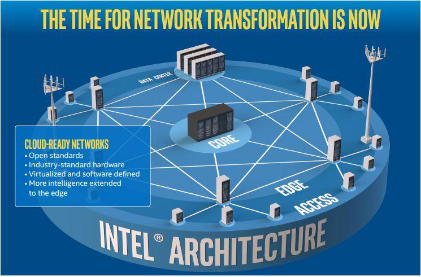
Intel announced that it will expand its Xeon processor D-1500 products and introduced a new Intel Ethernet controllers to enhance telecommunication network performance and bandwidth.


The announcement for the benefit of Intel's global telecommunications industry to bring more intelligent network service delivery.

Telecommunications network operators Americas Telecom has selected Intel as a technology partner in the Americas and Europe to upgrade their networks.

Intel will help telecom network operators to rapidly and cost-effective way to expand their infrastructure in order to better meet the needs of future things and 5G mobile technology.


Intel has been working with telecom network maker Cisco, South Korean operator SK Telecom and US carrier Verizon, accelerate the construction of a more flexible and sensitive network and lay the groundwork for 5G network.

Intel will provide support for the Inter-American Telecommunications, modernize its infrastructure in Latin America and Europe to accelerate the introduction of new services, automate their processes to reduce network operating costs.

More than 50 more than the use of the Intel Xeon processor D-1500 product family of networks, cloud storage, enterprise storage and networking system designs being developed.

The new Intel Ethernet multi-host controller FM10000 series combines Ethernet technology and switch resources for high-performance applications and dense communications network server platforms. With up to 200Gbps of high-bandwidth multi-host connectivity and multiple 100G Ethernet ports, providing superior packet-based processing power and greatly reduce between the server and the server's internal network traffic performance bottlenecks.

The new Intel Ethernet Controller X550 series is a cost-effective 0G Ethernet connectivity solutions, can improve the performance of servers and network data center applications.

SDN data center market in 2015 will increase by more than 70%

Data center SDN Advanced Research reports from Dell'Oro Group shows that in 2015 data centers SDN market is expected to grow more than 70%. 2015 marks an important milestone SDN, many Ethernet switch architecture approved and production deployment is underway.

"With the expansion of large-scale cloud providers to deploy SDN outside influence SDN Ethernet switch market in 2015 significantly improved," vice president of Dell'Oro Group AlanWeckel representation.

"Clearly, 2020 compared to today's data centers will look a big difference. With the stagnation of corporate customers and the expansion of spending from the AWS, Azure and other cloud service provider spending, we have seen overall network SDN and IT market impact. Looking generation 25GE and 50GE server access, AmazonAWS, Google and Microsoft Azure will drive the market development, and we believe that Dell plans to buy EMC is a prelude to further consolidation in the market, while equipment makers will also experience shuffle. "

Huawei together with China Telecom launched the world's largest SDN commercial backbone network construction

According to China Telecom official information display, Huawei won the bid in 2015, China Telecom IDC bearer Private Network Central Purchasing items, including IDC hosting special aggregation routers, access routers (including SDN controller), as well as route reflector device.

The project will cover the construction of six major national telecom base core data centers, as well as 15 core data center of the city, and over the entire network based on the 400G router platform, SDN introducing innovative new technologies and other related network, which will become the world's largest SDN commercial backbone network, to achieve China Telecom cloud base and IDC interconnection between the provinces, to fully protect the rapid deployment and operations of China Telecom IDC / cloud hosting service quality requirements.

By the end of 2014, China Telecom Internet transformation strategy proposed, will be many aspects of the Internet-based operators and service-based business foundation NE, public Internet applications, government and enterprise information technology applications, cloud and big data and enterprise IT operations and other Internet upgrading of focus, a new type of China Telecom to create a comprehensive, full implementation of "de-telecommunications" strategy. With the implementation of China Telecom Internet transformation of network infrastructure also needs to adapt to the Internet reconstructed to meet service bearer "active, fast, flexible, and open" and other needs, but based on the IDC SDN backbone bearer network construction has become China Telecom Future one to build a new data center-centric network architecture key starting point for China Telecom network transformation in terms of significance.

The project lasted for several months, a number of major manufacturers at home and abroad are actively involved, and ultimately Huawei 400G platform with a mature and stable core routers and extensive commercial experience accumulated SDN field, China Telecom preferred cooperation manufacturers, together with China Telecom jointly build SDN world's largest commercial operator backbone network projects. All along, Huawei is committed to telecom operators to build trade advantages, and actively participate in the global SDN program, continued optimization SDN architecture and solutions, and working in partnership with telecom operators, in a data center as the core network architecture change, to become the world Operators ideal ICT transformation partner.

MACOM released QSFP28 module chipset for data center applications

Simulation of RF, microwave and photonic semiconductor products supplier MACOM released its complete chipset for data center CWDM and PSM4 applications. The chipset contains a complete optronic integrated circuit (IC), you can achieve the lowest power consumption in QSFP28 package.

In order to meet market demand for high-speed data communications, the new large data centers continues to expand. Number 100G transceivers will grow exponentially, and the need for lower power consumption, smaller, lower-cost components. MACOM has been integrated into the high-speed semiconductor devices 100G transceiver and offers laser, optimized set of drives, CDR and TIA in one complete solution, with unique performance, power consumption, size and cost advantages.

The M37046 and M37049 MACOM is the lowest power, smallest four-channel transceiver CDR, with market-leading performance. MAOM-002301 and MAOM-002304 is the market's lowest-power single-channel and four-channel DML drivers, due to ease of assembly into the TOSA, they have been widely used in the market. In addition, MACOM of 127/129/131/133D-25C-LCG11 series covers CWDM DFB lasers and PSM4 wavelength, with a very wide operating temperature range. M03002 and M03102 are single-channel and four-channel TIA, 28G applications for the industry's lowest noise and power consumption. The complete solution is fully supported by a team of experts MACOM application to help transceiver designers shorten product time. In addition, the economies of scale but also bring significant cost advantages for transceiver manufacturers who use MACOM chipset.

High-speed Internet strategy VivekRajgarhia vice president, said: "This reflects the MACOM chipset for end users and the industry bring value by providing a comprehensive solution, we can reduce costs, improve energy efficiency and help customers deal with various high-speed network. challenge. "

Five network challenges of the future trend of development of enterprises

With the emergence of cloud computing and accelerate the deployment of large and ultra-large-scale data, data centers, network managers must constantly readjust and further development of the network. Under the impetus of this challenge, a variety of new technologies and new standards have emerged, not only can be used to improve and optimize the network capacity, security and flexibility, while controlling costs. Let us look at the top five trends in 2015 and the network to the user's meaning.

Trend 1: 802.11ac rapid spread

Enterprise networks are at the peak of a new era of mobile computing, tablet PCs and smart phones can be seen everywhere in the workplace. As the number and deployment of enterprise cloud services, mobile devices continues at an alarming rate of sustained development, network managers must rethink how they will provide the protection and control of enterprise computing resources and information access.

According to IEEE 802.11ac standard, 5G 802.11n wireless technology when compared to its predecessor, not only three times faster, the power efficiency is improved by six times, while maintaining the 802.11n and legacy 802.11b/g/a wireless interface interaction operability. Infonetics recent data show that sales of 802.11ac access points increased by nearly 10-fold in the past year. This gives enterprise technology managers to better manage and protect their network connection point tremendous pressure.


Figure 1: Wi-Fi technology evolution shows that the development process as well as the rapidly growing exponentially handling capacity over the past 15 years, currently 802.11ac (5G) has reached 3.6Gbps. 802.11ac access points 10-fold increase in sales to the enterprise has brought enormous pressure.

Trend 2: wiring closets 2.5G and 5G coexist

With 802.11ac Wi-Fi Wave Release 2 flow rate through the access point will be more than thousands of megabits per second, we need an access point and Ethernet switch port expansion to 1000 Base-T (1G) above. However, due to the length it has been put into use over five and six cable of millions of feet of business operations are seeking through this existing single pair unshielded twisted-pair copper to fill vacancies between 1G and 10G.

802.11ac Wave 2 standard will usher in a progressive multi-user MIMO antenna technology and other technologies to help the theoretical maximum wireless speed up to 6.93Gbps. With respect to the typical 10 times the speed of the Ethernet trail, this creates opportunities for faster Ethernet speeds and quickly upgrade to a rate of 2.5G and 5G. Although the newly installed equipment will be used wisely to support 10G super six cable, but most of the existing installed base will stay in 1Gbps, or when you need more than 1Gbps uplink rate using 2.5 / 5Gbps rate.

Existing programs in a variety of industries through existing five / six cable support 2.5G / 5Gbps same time, the industry needs a unified standard to avoid confusion between the various solutions and non-interoperability. This might give this potential emerging market adversely affected. The good news is, IEEE 802.3 standards bodies are working on the multi-rate Gigabit Ethernet BASE-T program by 2.5G and 5G used in enterprise access point.

The focus of this work is the need to achieve the goal in the near future and is currently installed through UTP (100 meters 2.5G) and six (100 meters 5G) cable. Because of limited bandwidth, convenient way to achieve this is to use a higher modulation scheme.

Join in the wiring closet Ethernet link protocol 2.5G and 5G rate, not only will achieve enterprise access point network bandwidth low-cost expansion, but will also provide more data rate options for IT professionals.

Trend 3: Data center 25G, 50G and 100G

Enterprise and cloud environments network operators must comply with technical roadmap carefully planned build its own network in order to expand based on changing needs. Typically, these carriers must maintain the lowest possible capital and operating expenditures (CAPEX / OPEX) while the balance of performance optimization. One way to achieve these often conflicting objectives is to upgrade to higher-speed Ethernet technology.

Experts predict that the biggest cloud service providers to upgrade to 100G Ethernet architecture, and low cost 25G and 50G will continue to be the majority of the other well-known companies in the data center of the main force. 25G / 50G Ethernet Alliance is a relatively new organization, it has its 25G and 50G Ethernet specification is open to all suppliers of data center ecosystem (royalty-free) to create and deploy interoperable Compliance product implementation. The standard can accelerate 25G and 50G Ethernet ports widely deployed, it also happens to be synchronized with the cloud architecture suitable for the introduction of 100G Ethernet.

25G / 50G standards may appear to be some kind of backwards, because 40G and 100G Ethernet already exists, but it is mainly used to meet the needs of lower-cost rate, especially low-cost speed demand cloud data center servers. For example, 25G and 10G wiring have substantially the same cost structure, but the performance is 2.5 times the 10G. Similarly, 50G cost is half of 40G, but the performance increased by 25%.

Trend 4: Cloud-level network

How can companies reduce mobile network costs while improving efficiency and flexibility of their IT infrastructure? Virtual networking, storage and servers are reshaping the way businesses use IT. Cloud computing plays a crucial role in this process, you can provide network access to computing resources and a huge amount of complex applications.

Cloud technology to provide more capacity to fully meet the third-party business or small business increasing demand, which can provide enterprises with a need to invest in new IT infrastructure will be able to increase the capacity of the route. Will host processing and data to the cloud, it frees capacity of network managers, they can create the capacity re-allocated to the data location and control device generates the data. Ethernet networks can be designed to achieve low latency and high bandwidth, can fully meet the needs of all the efficiencies of cloud computing to achieve its value.


Figure 2: Cloud-level network has three elements, namely, the physical network layer, network services and SDN and NFV platform support. The physical network layer elements can provide a blueprint for efficient network design. Low-cost network services can be expanded to achieve high performance for all workloads, while SDN and NFV can achieve dynamic service configuration and faster innovation and deployment.

Trend 5: Open Source Network

Cloud-level network without software is useless, and each part of the switch also requires the operating system. The software must provide a hardware-independent network operating system, an abstraction layer on a commercial switch chip, like Linux and Windows provide the same abstraction layer on the server side.
 
Eliminate patent barriers and allows developers to collaboration, debate, integration and motivation to each other, is an important advantage of open source network. Gartner predicts 2015 open source technology will be included in 85% of commercial software packages, 95% of major IT companies will use some elements of open source software.

For decades, customers have been buying servers, patent portfolio data storage, networking and software. Now, these customers require the system to use a different approach with, so open source software can be combined with existing hardware and its internal legacy systems. This method is expected to bring advantages to mix and match the speed, cost and innovation.

Traditional "one factory dominant" proprietary solutions are into "flourishing" multi-vendor mode. This can be a significant cost savings for customers in any market area and bring noteworthy performance optimization for them. And now the challenge has been transformed into how successfully integrated these systems suppliers. Fortunately, the server and PC market to provide a template, which can be through a new open-source hardware, open source software and open standards will combine all of this complete integration.

View source version on http://www.fiberonsale.com/news/five-network-challenges-of-the-future-trend-of-development-of-enterprises.html

European operator Colt launched SDN-based DCI business

European telecom operators Colt has launched on-demand SDN / NFV technology provides data center interconnection services DCNet as-a service. This enables the user to obtain business data center 10Gbps interconnection across Europe. Colt will be carried out next month test run wholesale customers and finance, media areas of business users. DCNet self-service will be the first port in the heart of London, Paris, Frankfurt and other places, 57 third-party data centers. Colt is expected in early 2016, this service will be extended to the whole of Europe and Asia-Pacific 150 data centers.

Colt representation, SDN / NFV feature will provide integration with cloud services, shorten the service provision progress, providing high SLA more flexible business model, the user can port-based self-service under a single and independent business changes. SDN will transform the telecommunications industry has brought fundamental business model, change the way operators and user interaction. Colt's Novitas plan is not just a technology upgrade, it is the transformation of a business model.

2016 100G technology in the network equipment market will be a breakthrough year

IHS today announced network ports: 1G, 2.5G, 10G, 40G, 100G report, the corresponding statistics for each port technology and the growth rate of speed.

"Deploying more than 1G network ports continue unabated, whether business or service provider. In general, the higher the port speed, the higher the growth rate, which means 40G and 100G are key growth areas of the market. However, in 2014, as China's massive increase in GPON OLT expenditure, as well as North America gigabit FTTH deployments, 2.5G products increased the most. "Matthias Machowinski IHS enterprise networks and video research director said. "Looking ahead, we expect 40G revenue began to fall in 2017, the demand for enterprise and data center move to a new release based QSFP 100G technology."

For operators of transmission networks, IHS research director believes that 2016 was a breakthrough year for 100G coherent technology, such as Google, Microsoft and Amazon to massive ultra-large-scale data center launched 100G Ethernet switching technology.

IHS expects: 1G / 2.5G / 10G / 40G / 100G port shipments in 2015 will be over 700 million, amounting to $ 45 billion, compared to 2014, 100G port shipments more than doubled, to 163,000 ports .

IHS predicted five years from 2014-2019, the global income 100G ports will be 137 percent compound annual growth rate (CAGR) growth.

IHS expects 10G networking port spending to grow 70%, 100G to grow 262% from 2015 to 2019

Lightcounting cut annual optical module market growth

Market research firm Lightcounting latest quarterly report in September this year a combination of the first half of global operators, Internet companies and communications equipment, devices and corporate earnings since the third quarter shipments data and dynamic communications companies. Their analysis shows some interesting results.

LC pointed out that the second quarter of this year compared to the year before, the investment in Internet companies in the field of large data centers increased by 7%, while telecom operators to invest in the telecommunications sector decreased by 12%. Reduce telecom operators to invest mainly receive complete the world's major telecom operators some major investment projects, such as China Mobile LTE deployment, while the growth rate of the Internet companies to invest in the situation significantly better than in previous years.

Year comparison, sales of data communications equipment manufacturers in the field of growth of 2%, telecommunications equipment grew by 4%. White box manufacturers continue to win market in the area of ​​data center equipment. In the field of telecommunications equipment, Huawei and ZTE continue to gain market share. Pressure on prices may be a factor, but operators have become cautious in the evolution of SDN / NFV may also be the cause.

Device manufacturers in the data communications segment grew 10%, an increase of 7% in the field of telecommunications. Increased deployment of 100Gbps device should be the reason behind this beautiful figure, the price is usually higher 100Gbps devices. Divided by product type, the following figure shows the different types of optical components market performance in the second quarter. Optical connector market growth, although high, but due to low prices, overall sales remain low, slightly higher than $ 50 million. Broadband construction to benefit from China's, FTTx market continued to maintain a rapid growth. China's future investment in LTE-building wireless networks will also stimulate the growth of optical device market. Overall, Ethernet and WDM optical devices is still the bulk of optical components market.

2015 2Q14 sales growth


In the August report, Lightcounting had predicted annual optical module market growth of more than 25%. But then some of the light module manufacturers lower growth, the Chinese market situation may change, Lightcounting decided to optical module market growth from 25% down to 15%. Even so, the annual light module market will reach $ 4 billion. The rapid development of emerging companies may supplement the decline of traditional manufacturers performance.

AOI publish data center with 100G optical engine

Analog and digital optical components supplier AOI (Applied Optoelectronics) has introduced 100Gbps optical engine for data center use. The product is built four laser, detector arrays, optical arrays and associated drive electronics for parallel 100Gbps optical modules and other design PSM4 QSFP28.

The main features of the product include:

• AOI Texas MBE Fab homemade laser chip

• Highly reliable non-seal design to improve the cost-effective

• Built-in laser driver and TIA chip simplifies design

• Patented thermal design

• Provide MSA compatible and pigtail packages

AOI indicates that the product has begun to provide samples, the amount of the year is expected to produce. According Lightcounting forecasts, bulk sales 100G QSFP28 module will appear in the second half of next year.

Cisco and INSPUR set up a joint venture company

During the time when the Chairman Xi Jinping visited the United States, Cisco and INSPUR jointly announced the establishment of China joint venture. The cooperation included in the Chinese market to resell Cisco's network equipment and jointly develop hardware and so on. This partnership will enable Cisco and INSPUR expand business coverage, and have a significant impact on the pattern of Chinese IT infrastructure market.

Since the 1990s, China has benefited from substantial investment in the network market, Cisco's business in China continued to maintain rapid growth. However, after 2013 the situation was reversed Snowden event, Cisco performance worsened in China, and continues to decline today. IDC data show that the first half of 2015 sales of Cisco's network equipment in China was only 81.3 percent in the first half of 2013, market share fell from 28.5% to 19.4%; At the same time, China's overall Internet market grew by 19.5%, Huawei, Rui Jie, ZTE and other domestic manufacturers market share increased from 27.2% to 46.3%. Chinese networking equipment market accounted for 10% of the world, there is still much room for development the United States and Europe. In recent years, China's Internet market has entered a stable period of development, but the growth rate is still far higher than the global level, especially in the data center, for any one of the international companies in terms of Chinese market can not be ignored.

China markets size of enterprise network equipment, 2013H1-2015H1

One as a mainstream server vendors, INSPUR also looking for a new growth point. Because there is no network product line, formerly INSPUR in competition with Huawei, HP and other vendors can not help but binding the hands. Collaboration with Cisco will help INSPUR improve their infrastructure product line. Cisco's networking products in conjunction with INSPUR own server, storage, cloud computing and other product lines, to provide users with more convenient INSPUR overall package solution. For INSPUR, the Cisco networking products is the best choice of partners, Cisco's leading technology products, but because of policy restrictions can not display their fists. INSPUR good government through their own relationships to help sell Cisco products, while INSPUR can learn from technology and experience to develop their own products.

China market size of X86 server, 2015H1

After the collaboration, Cisco and INSPUR will benefit. Cisco aid INSPUR can re-enter the market-related part of the government, is expected to return to the growth track, INSPUR may be in the server project sales of network equipment, add new sources of revenue. Early industry is expected the cooperation will focus on government and finance, Cisco in these two sectors, the affected self-control policy, business serious decline. In these two sectors in the two sides will focus on the data center market, so INSPUR can use their own existing client resources quickly into the market, in the data center network investments accounted for most of the switch, so that the data center switch will be the focus of bilateral cooperation products.

Cisco phasing out of these two years, Huawei, ZTE and Rui Jie, quick to seize its market share in the government and financial sectors, and now Cisco borrow INSPUR comeback, bound to give these companies create new pressures. H3C due to changes in ownership, etc., the first half of 2015, a drop in performance, this time in terms of Cisco's access to H3C will be worse. Network market contest resumed, arrived in the hands of the domestic manufacturers can keep market share, will begin to be more comprehensive test of the strength of the manufacturers. Competition will become more intense, thus further driving down prices, users can buy more cost-effective products, from this perspective, users will benefit from it.

Of course, before the joint venture has many problems, such as how the price setting, whether it will affect the existing channels, the depth of integration and other solutions can, how to solve these problems will test the sincerity and intelligence cooperation.

"China's Internet market, after nearly three decades of development, has been to the eve of change", IDC research manager Hu Xiangdong of China's Internet market, "said the transition to the third stage from the second stage, ICT depth of integration, SDN technology development period, network competition big change to take place, only close grasp of user needs, the introduction of competitive products and solutions, in order to have a foothold in the market. "

Huawei OCF define the next generation data center network architecture

With the big data, cloud computing and the Internet+, things booming, SDN global telecom circles in recent years become one of the hottest topics. Huawei in its 2015 Cloud Computing Conference (HCC 2015) released a cloud data center for next-generation data center network architecture - open cloud network architecture OCF (Open Cloud Fabric), through an open and decoupling of SDN network architecture enables cloud rapid business innovation.

SDN has become an inevitable trend, based on SDN's OCF create a new network architecture. It allows network further opening, from the top down to application-driven network, which is a big step forward network.

Network from the previous black box technology is moving towards open, otherwise it is impossible to match the application, computing, storage requirements driven by cloud, and Huawei in this respect walk in the forefront.

What is OCF?

Huawei definition of OCF, is a new data center network architecture, which is based SDN architecture thinking, the traditional closed network decoupled into data plane, control plane and service plane, three plane interworking via standard protocols, while highly compatible third-party products .

Open SDN program, has become the common needs of enterprises and industrial chain. A large number of companies are considering or are deploying SDN, the reason is very simple, cloud computing, big data, Internet+, the emergence of the Internet of Things requires the network to keep up with the support of various new applications. The existing network not flexible enough to meet the demand, SDN creates opportunities. Huawei's continuous investment in SDN field, Cloud Fabric from 2012's 1.0, 2014 2.0 2015 3.0, Huawei has been committed to promoting data center SDN development, OCF architecture announced today, will be long-term support data center SDN solve development programs.

Traditional network is closed, can not be dynamically adjusted according to user needs, and OCF through open protocols, will be adjusted to control the network and resources open to the user to achieve the best service by dynamically adjusting the control network.

OCF as demands for different types of open architecture client base in the data plane, provided by ONF OpenFlow 1.3 conformance certification of CloudEngine series data center switches, while facing the virtual network released a new generation CloudEngine 1800V virtual switch. In the control plane, the new release of cloud-oriented network Agile Controller 2.0 can achieve a unified policy management of physical and virtual networks and issued. In business plane, there will be more network applications to provide users, including network quality testing, safety-oriented policy definition applications and other business arrangement.

Future data center network will be decoupled and layered, future changes in the speed of data center operations will be in hours and minutes level, this rate is far unable to meet the needs of traditional networks, both in policy definition, network operations and management, and even business-oriented customization capabilities, the traditional networks have a great disadvantage. Huawei released OCF goal is to make the network more flexible and agile infrastructure, embrace cloud business changes.

OCF core components Highlights

OCF groundbreaking, and constitutes the core components of the same OCF many highlights. Among them, Huawei CloudEngine series switches get ONF certification issued by the OpenFlow 1.3, Huawei also became the first in the world and China's first manufacturer to obtain the certification. Testing and certification show, CloudEngine series switches meet the OpenFlow standard, enabling control and forwarding decoupling, and successful docking third party ODL, RYU, ONOS controller; at the same time, CloudEngine series switches support Hybrid model, can meet the networking needs of the traditional network , but also have the ability to OpenFlow network evolution model can help customers achieve a smooth upgrade legacy networks to SDN network, reducing network transformation risk and protect investments.

Huawei CloudEngine 1800V is for data center virtualization environments, distributed virtual switches, can be combined with Huawei CloudEngine series switches and Agile Controller controller hardware, to achieve a unified visualization and management of physical and virtual networks; at the same time, CloudEngine 1800V supports VMware, Microsoft, KVM and other mainstream virtualization platforms, and business unified bearer; in addition, it also supports the standardized northbound interfaces can be 1.0 / 1.3 interface and a variety of standard docking SDN controller through OpenFlow, the controller can also interface to it by OVSDB configuration and management.

Latest Agile Controller 2.0 is based on open architecture platform designed to meet the new generation of network-based SDN building aspirations. Agile Controller 2.0 provides the SDN architecture layered decoupling ability to achieve open interfaces and programmability based on business layer, and supports third-party docking mainstream cloud platform for network services automatically grant, its core functions include automated deployment, fine operation and maintenance and highly reliable clusters.

Industry for the realization of next-generation networks have different approaches, but the most critical is that the next hop of the network is open, open to innovation networks open opportunity for us to see more of the new stuff. And Huawei, our switches can be a third-party controller, our controllers can also be integrated, we hope to provide customers with a comprehensive open platform.

For customers, OCF open architecture brings tremendous value. OCF can provide external network open system-level capability, which is opening up the network as a whole, through the "physical Net + Virtual Network + controller" full open SDN solutions enable customers to build networks for their business demand, Achieving business agility to deploy, more refined operation and maintenance management, and more efficient use of resources, the overall cost savings ownership (TCO) while improving maintenance efficiency.

Open ecosystem of open architecture

Huawei has established around the OCF and cloud computing industry downstream partners on multiple levels of cooperation, and gradually build and enrich OCF industry ecosystem, allowing seamless integration of Internet and cloud IT, but also to play a more value, boosting cloud network calculate the user's business innovation. Currently, there are already a lot of partners' products and solutions are incorporated into Huawei's agile data center OpenLab open laboratory.

In the cloud operating system level, OCF has been achieved with Huawei FusionSphere, VMware, OpenStack, Microsoft and other mainstream cloud platform interoperability; network application level, and Puppet Labs, F5, Citrix and other network application vendors to cooperate; network security level, Huawei has been with the Checkpoint launch joint programs.

OpenLab is open ecosystem strategy we support, we will continue to SDN architecture in different levels of many manufacturers to include, from the bottom of the virtualization software to interconnection applications, controllers, not only from north to south, including the east-west It can be interconnected.

Huawei switches and general manager of the OSS product line Cheng Changqing field of corporate communications, said Huawei's network industry alliance partners to provide a good platform, based on the platform partners can publish their applications and products that can work together for customer acquisition and Huawei commercial success. Next, Huawei will further improve the developer environment, community technically allow partners to open faster and better user-oriented needs.

Currently, Huawei agile data center networking solutions Cloud Fabric has been successfully deployed in more than 80 countries around the world more than 1,000 data centers, SDN business partner is no lack of Century Internet, China Unicom, Tencent, Telefonica this global leader.

Corning preparing for a high-density data center cabling solutions EDGE8TM

Recently, Corning introduced a data center dedicated fiber cabling solutions EDGE8. "Corning EDGE8 program uses 8-core optical fiber modular structure, with a higher density per rack mounting. EDGE8 solution helps data center operators improve the user experience, to adapt the rate of evolving requirements and new standards evolution, and reduce procurement Uncertainty .EDGE8 cabling solution is to 40G, 100G, 400G upgrade the easiest and most flexible way. "Scott Gregg Kang Ningguang Communications Asia Pacific marketing manager for enterprise network recently said in an interview.

EDGE8 exactly match QSFP module, data center cabling easier

Scott pointed out that in order to meet the needs of the data center, Corning launched dedicated to data center EDGE8 system, which is based on 8-core fiber structure designed to perfectly match the latest QSFP optical module, it can achieve 100% utilization of the port rate, can achieve a more perfect port match. Because our new 8-core system using the new master PIN needle interventions with cable termination form, which is how it can simplify a lot of the kind jumper existing systems. In addition, the link system can be reduced Corning EDGE8 more than 35% of the loss. It can also support future 400Gbps applications. EDGE8 system uses 8-fiber MTP connectors help to simplify network deployment and optimize system configuration.

More energy-efficient

Compared with traditional copper cabling, as EDGE8 system uses the entire cable network, cable diameter will be much smaller than copper. For data centers, there will be greater in favor of air flow space, resulting in significant energy savings. For example, we are also a practical system for each port if you want to use copper consumed 2 watts of power, if the cable manner, the energy consumption of each port is only about 0.5 watts to 1 watt. And copper wiring compared to the same Gigabit network, cable energy only 1/4 or 1/2 of copper. When we consider such applications like cloud computing environment, it is a very large number of ports, thousands, tens of thousands or even hundreds of thousands of ports, each port of the energy savings add up, then it is very impressive.

Less time

And traditional field termination and splicing program compared to, whether EDGE8 EDGE program or traditional savings schemes can reach 90% of installation time. EDGE series, even when compared with Corning's own pre-terminated solution (Corning generation PNP-play mode), EDGE8 data center solution can save 35 percent of the time. Since the all-optical network based on EDGE platform, the new EDGE8 from the installation in terms of speed, it will also have to install fast EDGE an advantage.

Be prepared to look at the development of optical communication industry

Wall Street analyst team Doyle Publishing Ltd yesterday wrote on SeekingAlpha analysis of financial performance of the leading companies in the field of optical devices Finisar's. Their conclusion is pessimistic. If they have a good analysis, whether our industry in trouble fast.

In fact, a few days ago Finisar CEO Eitan Gertel sudden resignation if he had let the outside world because of poor financial performance of Finisar resign, although officially denied this claim Finisar. Doyle analysis to verify the financial problems may encounter Finisar. These problems can be summed up that is Finisar's profitability fell again, and the reason is behind the rise over the past few years COGS costs faster than sales growth. As a direct result, Finisar's ROA is only 0.07%, ROE was 0.1%, which means that management is no return to investors. This means that even if investors put money in the bank than to vote for Finisar in exchange for higher returns.

finisar financial

Finisar Doyle conclusion is not supported by the current earnings outlook for the stock now. We are not the financial industry, for their analysis and conclusions can not comment. But from the feeling we live in the optical communications industry, the costs continue to rise should be an indisputable fact, more than Finisar, other optical device manufacturers face the same. Finisar has the leading technology in fact there are new technologies and products to improve profitability, most of their competitors do not have this power.

Market prospects for the optical communication industry, all these years of rapid development FTTH, data center, driving the rapid growth of optical devices and fiber optic cable and other markets. Now China Mobile to host the 90 million core km of fiber optic cable is an example of the bidding market hot. Today, however, Doyle read this article, but people have some concerns. After all, the world macroeconomic situation is also far from clear, the Americans say that the increase does not raise interest rates to observe the performance of the Chinese economy, China's own ability to maintain 7% in the second half of the growth or problems. Optical communications market in Europe has just improved, and now into a refugee crisis. Russian oil prices dragged down the market far less. Development of optical communication market growth depends on the bandwidth consumed by an unstable economic situation is difficult to say to have stable bandwidth consumption growth. Today, we still see the Wall Street Journal said that Verizon is expected to next year's estimated income levels and unchanged from 2015, is one of the reasons behind the rapidly changing needs of consumers.

If even Huawei said his far without success, so for today's optical communications industry, especially optical components industry, vigilant even more indispensable.

IEEE 25GbE standard is nearing completion

Early in 2012, LightCounting mention data center transformation is unprecedented. Changes than in 2012 and now worse, numerous and diverse. In response to these changes, the Ethernet Alliance in the OFC showed their Ethernet standards development roadmap, they might consider 50Gb/s, 200Gb/s, 800Gb/s, or even higher speed standards.

IEEE802.3 working group at full speed to finalizing standards for 25GbE. Participants discuss their next step will be to do what the standard rate, is the time. Only a year ago, LightCounting reported 40GbE standard parallel everyone responded with great enthusiasm. Interesting, with serial 10Gb/s SFI interface 10GbE SFP+ module brings success. Serial 40GbE now nobody cares. We are keen to 40GbE serial standards prior to the recent hot issue on increasing the standard rate, especially the increase in the rate of 50GbE standards.

Ethernet speeds

Three changes simultaneously. They revolve around 50Gb/s:
1. The giant data center operators like Microsoft wants to upgrade their 40GbE storage links to 50Gb/s.
2.OIF nearly completed a series of 50Gb/s electrical interface standard.
3.IEEE Task Force decided to 400GbE standard uses 8x 50Gb/s serial interface. These interfaces will use PAM4.

Giant data center operators by two industries plan, will soon have '50GbE' link-up. On a NIC, they started using dual 25G SFP28 port, but this is not a standard serial 50GbE. Thus held two informal 50GbE impromptu meeting to discuss the scope of the future IEEE 50GbE standards.

Huawei SDN program with a mature commercial experience

RR+ quasi-real-time traffic tuning programs respond to the complicated flow

SDN achieve the separation of control and forwarding, unified network management, on-demand deployment, and flexible scheduling. The arrival of the era of big data to make flood of data continue to impact the existing network equipment, flow variability, bandwidth imbalance is a common problem in the existing network. Huawei RR+ program like Dujiangyan flood of data traffic tuning, near real-time to deal with complex traffic. RR+ program without changing the current network structure of the premise, the use of the IGP collect reporting network topology and, through the visual interface is presented to the customer; uTraffic collect raw traffic statistics, and then polymerized into polymeric flow suitable particle size; NetMatrix traffic analysis Mining and achieve User-defined management stream will flow adjustment policies or constraints notice SNC; SNC-based tuning information issued under NetMatrix calculate the flow path, and the flow path through the distributed repeater adjust the BGP protocol, and ultimately dynamic traffic Adjustment.

Value-added services on-demand deployment, provide new revenue streams for operators

By SDN controller business chain solutions, enables centralized control and management of value-added services, each tenant demand every business use. The value-added business resource pooling, you can customize each service for each tenant various value-added services, such as for tenants A business can be a custom FW (Firewall) business for tenants A business 2 custom LB (LoadBalance) business, but also that business tenants B 1 while custom FW and LB business. When tenants need to add or change business needs, simply re-use SDN service stream draining to the different business process network element can not only improve resource utilization NE business, while achieving a rapid and flexible deployment of business, More operators to develop differentiated value-added services to provide a strong support and new revenue sources. In addition, Huawei SDN technology provides an open API interface, enabling network resources and business collaboration through a unified service control platform; also achieved a satisfying link utilization threshold and specific traffic QOS premise, intelligent selection lowest settlement lines, investment savings for users.

VxLAN technology to achieve a large two-story exchange, resource sharing

Cloud data centers must meet the needs of the virtual machine migration, in VLAN network, the virtual machine can only be Layer 2 network migration, and in order to be able to support virtual machine migration, needs to be pre-configured VLAN on the Layer 2 network, resulting in VLAN Configuring abuse, affecting quarantine VLAN broadcast domain, reducing the efficiency of the network. VxLAN (Virtuale Xtensible Local Area Network) This standard is in this context came into being, it has become one of the mainstream technology industry. VxLAN is a large two-story virtual network expansion tunnel encapsulation technology, the main technical principle is to introduce the outer tunnel a UDP format, as the data link layer, and the original packet payload contents as a tunnel to transfer . Since the outer layer of the UDP as a transport means, just to meet the IP payload data can make up easily in two three-network transmission, to achieve DC large two-story exchange, resource sharing, virtual machine migration and service remote DC clusters. In addition, existing only 4094 VLAN virtual network identity, can not meet the current network of large-scale data center needs, VxLAN provide 16M tenants ID, to fully meet the needs of data center logical isolation large-scale users and businesses.

Core exit router using industry-leading 400G cluster router NE5000E

Huawei cluster router NE5000E core to meet the IDC export bulk forwarding and high reliability requirements. NE5000E cluster router chip technology leadership, the use of independent innovation Sloar3.0 chip, forwarding capacity per slot reach 400Gbps, can support 80,000 families while online watch high-definition video, and smooth expansion to 400G 2 + 8 cluster, the cluster capacity exceeding 100Tbps future smooth evolution to 1T platform can meet the demands of IDC long-term business development.

Huawei apply industry-leading 400G technology with mature commercial experience SDN programs and mainstream industry VxLAN new technology, help Guangxi Mobile to build infrastructure agility, the ability to open and operational intelligence, control centralized IDC network, and provide a richer Guangxi mobile business models and revenue sources. Huawei has been in continuous innovation capabilities continue to explore the development of the road network, to provide users with an open, efficient, intelligent and flexible network IDC, the real future of cloud collar, Zhaopin world.

Popular Posts