Vodafone Group has begun to implement fiber to the home (FTTH) projects in Ireland and Portugal, the project is 600 million euros is part of the Vodafone Group network expansion project.
Ireland will be Europe's first end-to-fiber optic network project conducted by the national electricity infrastructure. As part of SIRO (Vodafone Ireland ESB co-owned joint venture), Vodafone has started "before the end of 2018 to provide 1 Gbps fiber optic broadband network serving 51 cities and towns in Ireland" program.
Eligible to participate in the scheme must have more than 4,000 inhabitants. Carrigaline town of Cork County will be the first to get this fiber broadband service towns. According to the data show that Ireland does not exceed 50% of the fixed broadband subscribers bandwidth of 30M. Vodafone pointed out, SIRO of 1G (1000M) broadband project will bring revolutionary broadband experience Irish 500,000 homes and businesses.
Vodafone also announced plans to invest 125 million euros in Portugal FTTH network expansion plans before the end of 2016 to provide 1Gbps broadband network services for local 2.75 million homes and businesses. So far, Vodafone FTTH network covers 2.2 million homes and businesses in Portugal. In addition, Vodafone and France Telecom operator Orange also cooperate in the construction of gigabit FTTH network in Spain to provide broadband services to the local more than 200 million inhabitants. Meanwhile, Vodafone is working with the Italian electricity company Enel questionable establish a national FTTH network in the Italian plan.
Vodafone also reached an agreement with Swisscom, the market strategic partnership between the two sides extended to four years. The agreement will bring benefits roaming and high speed internet connection service broadband subscribers in Switzerland. Vodafone customers and corporate clients will roam when visiting Switzerland to Swisscom's broadband network.
Showing posts with label network. Show all posts
Showing posts with label network. Show all posts

Facebook will invest $ 300 million to build a data center in Taiwan
Taiwan government officials on the 2nd said, Facebook plans to build a data center in the vicinity, "Changhua HSR station" Taichung, Changhua County.
In this regard, Facebook also confirmed that the company is currently looking for a suitable location is indeed in Taiwan to build a data center, but has yet to make a final decision.
Changhua county government official said, Facebook has hired a consulting firm to help evaluate the six candidates for the position, the results of a position, "Changhua high-speed rail station" near the most promising. Changhua county government also said, Facebook in August this year has sent technical teams to evaluate the position.
It is reported that, Facebook plans to invest 10 billion Taiwan dollars (about 300 million US dollars) to build the data center. The data center will initially covering 6 hectares, and the final size will reach 20 hectares. Changhua county government also said, Facebook data center needs 16.1 kV power system, initially consume 1,000 tons of water per day.
Facebook is one of the most popular social network in Taiwan. According to Facebook said the number of months in Taiwan about 15 million active users. Facebook announced in January this year, will set up a small team in Taipei, in order to provide better technical support to Taiwan enterprises and application developers.
 |
| data center |
ONOS published SDN's latest operating system Emu
Open network operating system ONOS community, today announced the fifth edition of the operating system software. Pursuant before each edition are named alphabetically from one bird Avocet, traditional Black bird, Cardinal, Drake, and this version of the software is named after an Australian Emu ostrich named. This is also a year ONOS continuous release of the fifth edition of the software. ONOS indicate this release demonstrates the continued ONOS they will work together to create a real partnership effort SDN / NFV solutions. ONOS has quickly become a operators and equipment manufacturers can rely on it to create SDN / NFV solutions, the introduction of new business models, and from SDN / NFV business profitable platform.
This version of the software, including the contribution ONOS communities such as IP Multicast, improve SDN-IP platforms, including CORD (Central Office Re-Architected as a Data Center), packet / optical, and other key business functions SFC chain applications improve, and to project an open platform for the NFV OPNFV and OpenStack support.
ON.Lab engineering VP Bill Snow expressed, ONOS community continues to accelerate each quarter release, this release is becoming a habit for ONOS future success will be very important. They were very happy to see Emu published.
ONOS also announced the release of Emu version of the system including access to ECI, ClearPath Networks and participation from China BUPT FNlab like. Last month, Alcatel-Lucent also announced to join ONOS project.
Emu new features include:
Huawei to support OpenStack and OPNFV the Brahmaputra integrated contribution, Fujitsu predetermined resource subsystem work and support the work of CORD SK Telecom for providing mobile network.
IP Multicast --DirecTV multicast architecture will continue to contribute. To support multicast applications, ONOS create ONOS forward multicast applications MFWD.
GUI-ONOS new MFWD CLI and REST API supports external operators and application inspection modify MFWD state.
Business function chain - Huawei for VTN (virtual tenant network) system supports ONOS Contribute Layer 2 and Layer 3 virtual network applications and business functions IETF chain of SFC
CORD-- forthcoming and AT&T to expand field trials in the first half of next year
Adaptive streaming surveillance - Korea Electronics and Telecommunications Research Institute ETRI contribution
SDN-IP-- supports connection to external network applications, using BGP.
In the evaluation of LR, CORD and support for OpenStack and OPNFV is seen as the most important improvement in this edition ONOS operating system.
ONOS is an open source ON.Lab Management SDN network operating system, mainly for service providers and large enterprises the ability to create and deploy the hardware, including the white card switch. December 5, 2014, released the first version of the open source ONOS, and high-profile service providers and technology suppliers are involved in ONOS projects, such as AT&T, Cisco, Ciena, Ericsson, Huawei, NTT Communications and Telecom. ONOS is considered to be the leading IT vendors to OpenDaylight community a telecommunications countermeasures. Currently ONOS has been more and more telecom operators and equipment manufacturers support.
Development Status SDN technology
SDN technology I believe we are no stranger to many people even have ears hear the calluses. After a period of controversy, SDN has finally been recognized by some of the data center market, began expanding the size of the relevant market, the market size in 2015 is expected to SDN switches and controllers will be more than 1.4 billion US dollars, and by 2019, this figure will reach $ 12 billion. SDN technology data center has been gradually recognized by the market for the development of the data center has brought vitality, which just a few years ago raised when SDN technology is very different, a lot of technical conservatives no longer ignore the existence of SDN technology, began to accept even like SDN technology, so the market opportunity came out. Compared to a few years ago talk SDN technology, now we have begun to emerge scale commercial trial, but to the number of data centers are being tested SDN technology program, a thriving affect SDN technologies emerge.
SDN is a change in the traditional network technology, breaking the technical barriers to the traditional network, allowing network technology to open. In the data center, the only network technology is the most closed technique, each network technology manufacturers all play each, have a lot of proprietary technology, which makes a lot of network equipment interoperability difficult, to the development of network technology, data center development have brought resistance . The network has become a stumbling block to the rapid development of the data center, it must make changes to the network. It is in this context, SDN onto the stage was. Although SDN wonderful dance, can not understand the appreciation of the audience are seated audience, or even think of SDN danced well ugly, so the emergence of SDN be more challenged, the development of resistance is not small, but not the network Support giant companies, almost unable to move. Not long, cloud computing, big data, virtualization technologies are fire, these new technologies detonated a data center, however, these techniques rely on a network are SDN, which highlights the importance of the SDN, only have the ability to network SDN to cloud computing, big data, virtualization techniques communion. At this Internet giant manufacturers have to accept SDN, joint networking vendors strive together for the network open. This time, SDN really angry, especially since 2015, with SDN network technology based data centers around the world, the country is also true. Three operators SDN and network manufacturers to do the test in the actual deployment of network applications, three Internet giants have been deployed in the data center SDN technology, these SDN deployment has played a good role model, peace, human security, government, banks, etc. hundred hundred lines industry giants are beginning to test and deployment of SDN, SDN technology has been widely promoted.
SDN hot market is one thing. In fact, from a technical point of view, is not currently commercially available SDN SDN original definition, in accordance with the definition of SDN by the controller to automatically manage the entire network, issued a stream table, traffic forwarding through the flow meter. This design for completely new data center, can be adapted, but the face of massive existing data center, are facing can not be practical situation. Massive data center contains a variety of network equipment, different manufacturers, different protocols and different specifications, which SDN controller is also compatible with these devices can not be, and traditional network devices do not support flow table, so that the data center is not possible to deploy SDN, which will replace all of these devices, these devices for the data center is the most precious asset, needs to be replaced gradually, upgrading it to deploy SDN brought great difficulty. Even for the new data center, we need the support of all network devices send flow table, and now all network controller manufacturers can not compatible with each other, so that the construction of such a SDN network, you can only choose an online vendor of all devices and controllers , which for a data center is very negative, which will purchase network equipment and a lack of future devices on the network operation and maintenance bargaining power, so in general the data center will purchase two to three network equipment manufacturers of equipment, compared with each other, merit-based selection, Thus there is a number in the network of network equipment, SDN nature can not be deployed, SDN technology to unify the online world is still a long way to go.
The current status of data centers SDN technology applications actually uses two deployment options, one is no controller scheme, which is clearly still a need for manual configuration of network equipment, changes in servers, network devices need to manually do some networking configuration change, but also the deployment of such networks VXLAN, NFV, TRILL and other SDN with technology, these techniques can be realized through a virtual machine across a data center server stateless migration, which no controller program but also to allow data center in the future Prepare to have the controller direction; the other is to have controller solutions, network equipment in the fiber optic interconnect good, good basic configuration interconnect port after delivering network configuration by the controller, when issued not flow table configuration, but the actual network configuration, such as ARP, MAC, routing these network elements to achieve up among all the devices within the network. When such change or increase during network equipment NE, own calculation by the controller to automatically deliver the configuration, which will greatly reduce the workload of operation and maintenance, the benefits it brings to the data center is obvious. This program, although not with a controller flow table under real hair, but already has a network of automated management software capabilities, the most important is that such programs can be compatible with existing data center network, is currently the most popular SDN program, which Species SDN program is not lofty, very down to earth, it was widely recognized. The last is a natural flow table SDN standard definition programs, this ideal SDN program, in fact, there is little use, but in some technical strength of strong research data center testing is still relatively far away from the actual commercial.
Although SDN applications and SDN standards vary, but gained more recognition in the data center began large-scale deployments. This SDN program is still not break the barriers between network technology, manufacturers of controllers on different networks have different, because there is no flow table, naturally they do not comply with OpenFlow protocol, so the current controller for manufacturers but also between the various networks closed, not for outsiders. This SDN solutions for data center operation and maintenance convenience brought on, but still not breaking the blockade network between manufacturers, have to say is a pity. However, SDN development just on the right track. I believe that with the white box switch mature, chip manufacturers on OpenFlow support is getting better, the real SDN technology will obtain greater future development, data center network inevitably more open.
Scotland Glasgow CityFibre Construction of the new gigabit fiber optic broadband network
UK network infrastructure provider - CityFibre, has announced the construction of ultra-high-speed fiber access network in Glasgow, Glasgow in Scotland to build a third Gigabit fiber broadband city. CityFibre said it would cooperate with local partners HighNet network construction starting in early 2016. After the completion of Glasgow broadband speeds up to 100 times the average speed of the UK, in order to better meet the needs of Glasgow for future high-bandwidth services.
CityFibre said network construction will start with the Glasgow city center. The next year there are more than 7,000 businesses near the city center can get gigabit broadband services. After the final completion of the network has more than 15,000 businesses benefit. CityFibre had already deployed a fiber optic network in the United Kingdom Aberdeen, Coventry, Edinburgh, Peterborough and York based on his "Well Planned City" model.
CityFibre company CEO Greg Mesch said he was pleased to start a new Gigabit urban construction in Scotland. HighNet customer base is the key to the success of this network. After the network is completed, CityFibre will become the second largest broadband operator BT Openreach away.
Xtera 100G equipment to win West African submarine cable deployment
Xtera Optical transmission equipment manufacturers, today announced its Nu-wave Optima obtain optical transmission system connecting West Africa to Europe MainOne submarine cable deployment.
MainOne to start operations in July 2010, connecting the West African country, Nigeria, Ghana to Portugal in Europe, the main access points include Portugal Seixal, Accra, Ghana, Accra, Lagos, Nigeria and Morocco, the Canary Islands, Senegal and Ivory coast with branches, after upgrading the total transmission capacity of over 10Tbps.
MainOne submarine cable operating company CEO Funke Opeke said that West African countries are experiencing the information explosion, this year has experienced rapid growth in network traffic, which brings the urgent need for network upgrades. As a major supplier of Eight West African coastal data traffic, MainOne about to connect the South-South region of Cameroon and Nigeria, MainOne need for further deployment of advanced technology to meet customers' demand for reliable high-speed communications services.
H3C Connect+: let the data center, "Moving"
In the wave of the Internet+ boom, driven by the gradual expansion of construction scale data centers, data center hosting services network is facing pressure surge, operation and maintenance more difficult, how to solve this problem has become the industry focus. Recently, large interconnected Hangzhou H3C Technologies Co., Ltd. (referred to as "H3C") at the Connect+ strategic conference to launch the application-driven data center solutions, to provide users with better data center business resilience deployment, unified management It provides the most practical solution.
Traditional data center construction as a project, each application needs to set by the network, compute, storage, consisting of the underlying architecture, traditional data center is "solid", lack of flexibility and scalability. With the development of business, increase application and data center management software carries more, increasingly redundant system, if the business needs to be adjusted, it is necessary to change the data center architecture, and traditional manual modification high error rate, as well as the deployment of business out slow. In addition, once the network equipment problems, it will affect the business operation of the entire data center to the enterprise serious economic losses.
New IT technology-driven data center transformation, has been one of the key H3C concern. Faced with the user's data center build for the future development, Connect+ H3C's has a very clear point, that is, on the basis of the new release of application-driven network architecture, based on scenarios for data center applications, the development of application-driven data center solutions to achieve business elastically stretchable, minimalist operation and maintenance, to build end service chain, to better integrate the large Internet Connect+ strategic landing.
From the characteristics of view, H3C application-driven data center solutions through hardware resources, NFV pool technology, as well as a cluster controller upward VCFC build resilient network, flexible scheduling resources to service deployment easier; at the same time With the overall platform, form the entire network hierarchy management, resource automatically migrate, there is a problem in the system or re-deployment process, the formation of the business system does not perceive the state, complete and correct operation.
For users, H3C application-driven data center solutions bring value that allows the user via a standard infrastructure, software-defined data center gives the ability to implement the entire network service elastically scalable, automated intelligence and secure. Data Center Planning for confusion often encountered during operation and maintenance, the user can make use of H3C solutions, business address and Internet address are independent, simplifying planning and realization of a one-time physical network configuration, make operation and maintenance easier management more efficient.
In practice, these values have also been tested, such as Tencent data center by deploying H3C application-driven data center solutions, successfully used to take 3-5 days to multiple data center services on-line, the deployment is completed within 1 day , efficiency is improved by 70%. In addition, Tencent also through network virtualization to achieve IT rational allocation of resources, making the effective and rational use of resources, greatly reducing the cost of investment.
Currently, software drivers, application of the concept of the first, has become the industry generally accepted direction. For data center construction, the floor of the road to achieve these concepts is still very long. To be sure, flexible, dynamic data center is the future trend, I believe that with the help of three communications in China, there will be more users join the network change to application-driven parade, with new IT technology to meet the challenges of large Internet era.
Coriant release pluggable optical layer solutions
Coriant innovative network solutions provider recently released for flexible high-speed metropolitan area network applications, to meet the needs of a variety of fixed and mobile applications pluggable optical layer having innovative and cost of the solution.
Coriant pluggable optical layer to a full range of optical layer device into a series of small form-factor pluggable devices, including amplifiers, VOA, power monitor, together light beam splitter, WSS, and so on. By providing mixing and matching various functional devices, pluggable optical layer so that operators can customize the metro optical network without the need to pay for unwanted features. When the end user when there is new demand, new features can be quickly and economically by simply adding new devices to implement, which can protect past investments.
Small size, low power consumption, with support for high-density 10G and 100G optical transmission, Coriant pluggable optical layer solutions for carrier metro network bandwidth upgrade, expand capacity to the metro edge light provides a highly cost-effective solution. This solution supports a range of metro topologies and structures, such as point to point, ring, ROADM, to provide seamless undisturbed for operators to upgrade to the full ROADM capability. Compared to traditional solutions, can save costs by more than 30%, allows operators to gradually increase demand deployment. Pluggable optical layer solution will be the first application in 7100 Coriant packet optical transport platform.
Ekinops demonstrate interoperability of their equipment SDN
France Ekinops optical transport equipment vendor interoperability showcase recent performance of its DWDM optical transmission equipment and open source SDN controller. Ekinops announced that its 360DWDM system is proven interoperability with the open source operating system under ONOS SDN network project. The experimental research institutions in France b<>com conduct, which is in the network management field of new technologies, especially the SDN has a wealth of experience.
In tests, Ekinops and b<>com design and development of an interface layer SDN controllers and network management agreement between the Ekinops 360 platform together. Throughout the experiment includes a net-like structure composed of a plurality of 360 ROADM nodes. For this experiment, ONOS controller to create a 100Gbps wavelength line and automatically allocated in the mesh.
Ekinops company CTO Francois X. Ollivier said the experiment was very successful, demonstrating the ability to provide support SDN Ekinops DWDM layer of a solution for carriers.
b<>com also said to 5G network evolution needs more flexible and automation products and services. SDN / NFV based on the concept that this jointly developed interface with Ekinops fully meet the physical transmission layer level management software based on their higher rates of 100G or network management requirements, support NFV applied to a fiber network.
2019 Data Internet market will reach nearly $ 5 billion
ACG research firm expects the global optical fiber data center interconnect market will grow from $ 1.1 billion in 2014 to $ 4.7 billion in 2019, a compound annual growth rate of 44.9%.
"The growth is mainly affected by the fiber DCI markets services to data center and cloud migration demand-driven, because service providers need to simplify deployment model and deliver new services and differentiated services", ACG intelligent transport network Practice Leader Tim Doiron said, "The new expansion data center deployments are subject to a variety of service providers including Internet content providers, network service providers and swap providers and promote business. As more and more functions to develop into automation and virtualization, data center interconnect on the capacity, flexibility and versatility of demand will continue to grow, promoting reliable, cost-effective high-speed data center interconnects demand is also a corresponding increase. "
ACG also evaluated the fiber DCI product sales trends, including long distance and metro applications, whether it is large or small multi-slot rack device packaged fiber accessories. ACG platform is expected to Metro DCI (DCI connection support distances up 150km) will continue to dominate long-distance applications. However, metro and long-distance category CAGR will reach 51.5% and 24.6%.
During 2014 to 2019, especially in North America will continue to lead the Americas DCI fiber sales. DCI markets in Europe, Middle East and Africa and the Asia-Pacific region has grown rapidly in the past few years, but still only half the American market.
According to ACG, on the platform types, most optical fiber DCI deployed using a multi-slot chassis products. However, a big wave SFF-like platforms, such as Infinera's Cloud Xpress, Ciena's Waveserver, ADVA Optical Networking's FSP3000 Cloudconnect and 1FINITY T100 have been or are being paved the way to market Fujitsu.
Visible light communication studies major breakthrough
Information Engineering University, led by the commitment of the State 863 Program "visible light communication system key technology research" project recently achieved a major breakthrough, real-time communications visible in one fell swoop rate increased to 50Gbps, equivalent to 0.2 seconds to complete a high-definition movie downloads, is currently 5 times the publicly reported the highest international level, the relevant results have been through the national Ministry of Industry and Information Technology Research Institute of Telecommunications Transmission testing and certification.
Visible light communication is the use of semiconductor lighting (LED lamp) light to achieve "a light will be able to access," the new high-speed data transmission technology, its spectral bandwidth is the next generation of wireless radio spectrum bandwidth currently in use in recent times, is a broad application prospects One of communications technology. The unique anti-jamming technology, anti-interception, high-speed broadband access and other capabilities, it has significant application needs and development prospects in the field of high performance computer communications equipment, phased array radar, ships and so on.
Chinese Academy of Engineering, Information Engineering University professor Wu Xing Jiang said that at present, the world has about 44 billion lamps lighting network composed of tens of billions of LED lighting equipment and other equipment to build a giant fusion of visible light communications network. It is envisaged that after the next large-scale visible light communication, each lamp can be used as a high-speed network hotspot, people waiting for the bus in the street can download several movies on the plane, but also can take advantage of high-speed wireless Internet access, LED light source meet the indoor network, networking, car networking, Industry 4.0, secure payment, smart city, defense communications, wireless communication network end demand for Internet + provides a new low-cost access methods.
Information Engineering University is the earliest visible light communication technology research and development and scientific research units, is the responsibility of the State Standardization visible light communication unit, set up a "Chinese visible light communication industry technology innovation strategic alliance." The school academician Wu Xing Jiang, Professor Yu Hongyi research team responsible for a series of key technology breakthroughs, among the international forefront of visible light communications research and development.
Intel is how to enhance the telecom network?
Intel announced that it will expand its Xeon processor D-1500 products and introduced a new Intel Ethernet controllers to enhance telecommunication network performance and bandwidth.
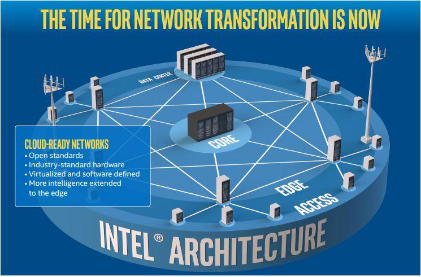
The announcement for the benefit of Intel's global telecommunications industry to bring more intelligent network service delivery.
Telecommunications network operators Americas Telecom has selected Intel as a technology partner in the Americas and Europe to upgrade their networks.
Intel will help telecom network operators to rapidly and cost-effective way to expand their infrastructure in order to better meet the needs of future things and 5G mobile technology.

Intel has been working with telecom network maker Cisco, South Korean operator SK Telecom and US carrier Verizon, accelerate the construction of a more flexible and sensitive network and lay the groundwork for 5G network.
Intel will provide support for the Inter-American Telecommunications, modernize its infrastructure in Latin America and Europe to accelerate the introduction of new services, automate their processes to reduce network operating costs.
More than 50 more than the use of the Intel Xeon processor D-1500 product family of networks, cloud storage, enterprise storage and networking system designs being developed.
The new Intel Ethernet multi-host controller FM10000 series combines Ethernet technology and switch resources for high-performance applications and dense communications network server platforms. With up to 200Gbps of high-bandwidth multi-host connectivity and multiple 100G Ethernet ports, providing superior packet-based processing power and greatly reduce between the server and the server's internal network traffic performance bottlenecks.
The new Intel Ethernet Controller X550 series is a cost-effective 0G Ethernet connectivity solutions, can improve the performance of servers and network data center applications.
The announcement for the benefit of Intel's global telecommunications industry to bring more intelligent network service delivery.
Telecommunications network operators Americas Telecom has selected Intel as a technology partner in the Americas and Europe to upgrade their networks.
Intel will help telecom network operators to rapidly and cost-effective way to expand their infrastructure in order to better meet the needs of future things and 5G mobile technology.
Intel has been working with telecom network maker Cisco, South Korean operator SK Telecom and US carrier Verizon, accelerate the construction of a more flexible and sensitive network and lay the groundwork for 5G network.
Intel will provide support for the Inter-American Telecommunications, modernize its infrastructure in Latin America and Europe to accelerate the introduction of new services, automate their processes to reduce network operating costs.
More than 50 more than the use of the Intel Xeon processor D-1500 product family of networks, cloud storage, enterprise storage and networking system designs being developed.
The new Intel Ethernet multi-host controller FM10000 series combines Ethernet technology and switch resources for high-performance applications and dense communications network server platforms. With up to 200Gbps of high-bandwidth multi-host connectivity and multiple 100G Ethernet ports, providing superior packet-based processing power and greatly reduce between the server and the server's internal network traffic performance bottlenecks.
The new Intel Ethernet Controller X550 series is a cost-effective 0G Ethernet connectivity solutions, can improve the performance of servers and network data center applications.
Huawei together with China Telecom launched the world's largest SDN commercial backbone network construction
According to China Telecom official information display, Huawei won the bid in 2015, China Telecom IDC bearer Private Network Central Purchasing items, including IDC hosting special aggregation routers, access routers (including SDN controller), as well as route reflector device.
The project will cover the construction of six major national telecom base core data centers, as well as 15 core data center of the city, and over the entire network based on the 400G router platform, SDN introducing innovative new technologies and other related network, which will become the world's largest SDN commercial backbone network, to achieve China Telecom cloud base and IDC interconnection between the provinces, to fully protect the rapid deployment and operations of China Telecom IDC / cloud hosting service quality requirements.
By the end of 2014, China Telecom Internet transformation strategy proposed, will be many aspects of the Internet-based operators and service-based business foundation NE, public Internet applications, government and enterprise information technology applications, cloud and big data and enterprise IT operations and other Internet upgrading of focus, a new type of China Telecom to create a comprehensive, full implementation of "de-telecommunications" strategy. With the implementation of China Telecom Internet transformation of network infrastructure also needs to adapt to the Internet reconstructed to meet service bearer "active, fast, flexible, and open" and other needs, but based on the IDC SDN backbone bearer network construction has become China Telecom Future one to build a new data center-centric network architecture key starting point for China Telecom network transformation in terms of significance.
The project lasted for several months, a number of major manufacturers at home and abroad are actively involved, and ultimately Huawei 400G platform with a mature and stable core routers and extensive commercial experience accumulated SDN field, China Telecom preferred cooperation manufacturers, together with China Telecom jointly build SDN world's largest commercial operator backbone network projects. All along, Huawei is committed to telecom operators to build trade advantages, and actively participate in the global SDN program, continued optimization SDN architecture and solutions, and working in partnership with telecom operators, in a data center as the core network architecture change, to become the world Operators ideal ICT transformation partner.
Huawei by ONF's first multi-vendor wireless backhaul SDN PoC test
Huawei in October announced that it has with the Open Network Foundation (ONF) in Madrid, Spain successfully tested proof of concept (PoC). This test provides venue for by the Spanish telecommunications Telefonica and IMDEA Networks, as well as four wireless transmission manufacturers and router vendors are participating in the trial.
The trial aims to encourage open SDN through further development of wireless transmission mechanism. But also to demonstrate through the use of open-source network operating system controller can achieve a multi-layer optimization SDN.
PoC two use cases were verified, empty response capacity and energy used to verify the ability to adapt to wireless backhaul demand for traffic; traffic shaping is to verify the ability of multi-vendor network coordinated response backhaul network status changes, such as weather, etc. traffic causes changes.
Huawei's SDN RTN900 equipment and OpenFlow Interface debut in this test.
Five network challenges of the future trend of development of enterprises
With the emergence of cloud computing and accelerate the deployment of large and ultra-large-scale data, data centers, network managers must constantly readjust and further development of the network. Under the impetus of this challenge, a variety of new technologies and new standards have emerged, not only can be used to improve and optimize the network capacity, security and flexibility, while controlling costs. Let us look at the top five trends in 2015 and the network to the user's meaning.
Trend 1: 802.11ac rapid spread
Enterprise networks are at the peak of a new era of mobile computing, tablet PCs and smart phones can be seen everywhere in the workplace. As the number and deployment of enterprise cloud services, mobile devices continues at an alarming rate of sustained development, network managers must rethink how they will provide the protection and control of enterprise computing resources and information access.
According to IEEE 802.11ac standard, 5G 802.11n wireless technology when compared to its predecessor, not only three times faster, the power efficiency is improved by six times, while maintaining the 802.11n and legacy 802.11b/g/a wireless interface interaction operability. Infonetics recent data show that sales of 802.11ac access points increased by nearly 10-fold in the past year. This gives enterprise technology managers to better manage and protect their network connection point tremendous pressure.

Figure 1: Wi-Fi technology evolution shows that the development process as well as the rapidly growing exponentially handling capacity over the past 15 years, currently 802.11ac (5G) has reached 3.6Gbps. 802.11ac access points 10-fold increase in sales to the enterprise has brought enormous pressure.
Trend 2: wiring closets 2.5G and 5G coexist
With 802.11ac Wi-Fi Wave Release 2 flow rate through the access point will be more than thousands of megabits per second, we need an access point and Ethernet switch port expansion to 1000 Base-T (1G) above. However, due to the length it has been put into use over five and six cable of millions of feet of business operations are seeking through this existing single pair unshielded twisted-pair copper to fill vacancies between 1G and 10G.
802.11ac Wave 2 standard will usher in a progressive multi-user MIMO antenna technology and other technologies to help the theoretical maximum wireless speed up to 6.93Gbps. With respect to the typical 10 times the speed of the Ethernet trail, this creates opportunities for faster Ethernet speeds and quickly upgrade to a rate of 2.5G and 5G. Although the newly installed equipment will be used wisely to support 10G super six cable, but most of the existing installed base will stay in 1Gbps, or when you need more than 1Gbps uplink rate using 2.5 / 5Gbps rate.
Existing programs in a variety of industries through existing five / six cable support 2.5G / 5Gbps same time, the industry needs a unified standard to avoid confusion between the various solutions and non-interoperability. This might give this potential emerging market adversely affected. The good news is, IEEE 802.3 standards bodies are working on the multi-rate Gigabit Ethernet BASE-T program by 2.5G and 5G used in enterprise access point.
The focus of this work is the need to achieve the goal in the near future and is currently installed through UTP (100 meters 2.5G) and six (100 meters 5G) cable. Because of limited bandwidth, convenient way to achieve this is to use a higher modulation scheme.
Join in the wiring closet Ethernet link protocol 2.5G and 5G rate, not only will achieve enterprise access point network bandwidth low-cost expansion, but will also provide more data rate options for IT professionals.
Trend 3: Data center 25G, 50G and 100G
Enterprise and cloud environments network operators must comply with technical roadmap carefully planned build its own network in order to expand based on changing needs. Typically, these carriers must maintain the lowest possible capital and operating expenditures (CAPEX / OPEX) while the balance of performance optimization. One way to achieve these often conflicting objectives is to upgrade to higher-speed Ethernet technology.
Experts predict that the biggest cloud service providers to upgrade to 100G Ethernet architecture, and low cost 25G and 50G will continue to be the majority of the other well-known companies in the data center of the main force. 25G / 50G Ethernet Alliance is a relatively new organization, it has its 25G and 50G Ethernet specification is open to all suppliers of data center ecosystem (royalty-free) to create and deploy interoperable Compliance product implementation. The standard can accelerate 25G and 50G Ethernet ports widely deployed, it also happens to be synchronized with the cloud architecture suitable for the introduction of 100G Ethernet.
25G / 50G standards may appear to be some kind of backwards, because 40G and 100G Ethernet already exists, but it is mainly used to meet the needs of lower-cost rate, especially low-cost speed demand cloud data center servers. For example, 25G and 10G wiring have substantially the same cost structure, but the performance is 2.5 times the 10G. Similarly, 50G cost is half of 40G, but the performance increased by 25%.
Trend 4: Cloud-level network
How can companies reduce mobile network costs while improving efficiency and flexibility of their IT infrastructure? Virtual networking, storage and servers are reshaping the way businesses use IT. Cloud computing plays a crucial role in this process, you can provide network access to computing resources and a huge amount of complex applications.
Cloud technology to provide more capacity to fully meet the third-party business or small business increasing demand, which can provide enterprises with a need to invest in new IT infrastructure will be able to increase the capacity of the route. Will host processing and data to the cloud, it frees capacity of network managers, they can create the capacity re-allocated to the data location and control device generates the data. Ethernet networks can be designed to achieve low latency and high bandwidth, can fully meet the needs of all the efficiencies of cloud computing to achieve its value.

Figure 2: Cloud-level network has three elements, namely, the physical network layer, network services and SDN and NFV platform support. The physical network layer elements can provide a blueprint for efficient network design. Low-cost network services can be expanded to achieve high performance for all workloads, while SDN and NFV can achieve dynamic service configuration and faster innovation and deployment.
Trend 5: Open Source Network
Cloud-level network without software is useless, and each part of the switch also requires the operating system. The software must provide a hardware-independent network operating system, an abstraction layer on a commercial switch chip, like Linux and Windows provide the same abstraction layer on the server side.
Eliminate patent barriers and allows developers to collaboration, debate, integration and motivation to each other, is an important advantage of open source network. Gartner predicts 2015 open source technology will be included in 85% of commercial software packages, 95% of major IT companies will use some elements of open source software.
For decades, customers have been buying servers, patent portfolio data storage, networking and software. Now, these customers require the system to use a different approach with, so open source software can be combined with existing hardware and its internal legacy systems. This method is expected to bring advantages to mix and match the speed, cost and innovation.
Traditional "one factory dominant" proprietary solutions are into "flourishing" multi-vendor mode. This can be a significant cost savings for customers in any market area and bring noteworthy performance optimization for them. And now the challenge has been transformed into how successfully integrated these systems suppliers. Fortunately, the server and PC market to provide a template, which can be through a new open-source hardware, open source software and open standards will combine all of this complete integration.
View source version on http://www.fiberonsale.com/news/five-network-challenges-of-the-future-trend-of-development-of-enterprises.html
Trend 1: 802.11ac rapid spread
Enterprise networks are at the peak of a new era of mobile computing, tablet PCs and smart phones can be seen everywhere in the workplace. As the number and deployment of enterprise cloud services, mobile devices continues at an alarming rate of sustained development, network managers must rethink how they will provide the protection and control of enterprise computing resources and information access.
According to IEEE 802.11ac standard, 5G 802.11n wireless technology when compared to its predecessor, not only three times faster, the power efficiency is improved by six times, while maintaining the 802.11n and legacy 802.11b/g/a wireless interface interaction operability. Infonetics recent data show that sales of 802.11ac access points increased by nearly 10-fold in the past year. This gives enterprise technology managers to better manage and protect their network connection point tremendous pressure.
Figure 1: Wi-Fi technology evolution shows that the development process as well as the rapidly growing exponentially handling capacity over the past 15 years, currently 802.11ac (5G) has reached 3.6Gbps. 802.11ac access points 10-fold increase in sales to the enterprise has brought enormous pressure.
Trend 2: wiring closets 2.5G and 5G coexist
With 802.11ac Wi-Fi Wave Release 2 flow rate through the access point will be more than thousands of megabits per second, we need an access point and Ethernet switch port expansion to 1000 Base-T (1G) above. However, due to the length it has been put into use over five and six cable of millions of feet of business operations are seeking through this existing single pair unshielded twisted-pair copper to fill vacancies between 1G and 10G.
802.11ac Wave 2 standard will usher in a progressive multi-user MIMO antenna technology and other technologies to help the theoretical maximum wireless speed up to 6.93Gbps. With respect to the typical 10 times the speed of the Ethernet trail, this creates opportunities for faster Ethernet speeds and quickly upgrade to a rate of 2.5G and 5G. Although the newly installed equipment will be used wisely to support 10G super six cable, but most of the existing installed base will stay in 1Gbps, or when you need more than 1Gbps uplink rate using 2.5 / 5Gbps rate.
Existing programs in a variety of industries through existing five / six cable support 2.5G / 5Gbps same time, the industry needs a unified standard to avoid confusion between the various solutions and non-interoperability. This might give this potential emerging market adversely affected. The good news is, IEEE 802.3 standards bodies are working on the multi-rate Gigabit Ethernet BASE-T program by 2.5G and 5G used in enterprise access point.
The focus of this work is the need to achieve the goal in the near future and is currently installed through UTP (100 meters 2.5G) and six (100 meters 5G) cable. Because of limited bandwidth, convenient way to achieve this is to use a higher modulation scheme.
Join in the wiring closet Ethernet link protocol 2.5G and 5G rate, not only will achieve enterprise access point network bandwidth low-cost expansion, but will also provide more data rate options for IT professionals.
Trend 3: Data center 25G, 50G and 100G
Enterprise and cloud environments network operators must comply with technical roadmap carefully planned build its own network in order to expand based on changing needs. Typically, these carriers must maintain the lowest possible capital and operating expenditures (CAPEX / OPEX) while the balance of performance optimization. One way to achieve these often conflicting objectives is to upgrade to higher-speed Ethernet technology.
Experts predict that the biggest cloud service providers to upgrade to 100G Ethernet architecture, and low cost 25G and 50G will continue to be the majority of the other well-known companies in the data center of the main force. 25G / 50G Ethernet Alliance is a relatively new organization, it has its 25G and 50G Ethernet specification is open to all suppliers of data center ecosystem (royalty-free) to create and deploy interoperable Compliance product implementation. The standard can accelerate 25G and 50G Ethernet ports widely deployed, it also happens to be synchronized with the cloud architecture suitable for the introduction of 100G Ethernet.
25G / 50G standards may appear to be some kind of backwards, because 40G and 100G Ethernet already exists, but it is mainly used to meet the needs of lower-cost rate, especially low-cost speed demand cloud data center servers. For example, 25G and 10G wiring have substantially the same cost structure, but the performance is 2.5 times the 10G. Similarly, 50G cost is half of 40G, but the performance increased by 25%.
Trend 4: Cloud-level network
How can companies reduce mobile network costs while improving efficiency and flexibility of their IT infrastructure? Virtual networking, storage and servers are reshaping the way businesses use IT. Cloud computing plays a crucial role in this process, you can provide network access to computing resources and a huge amount of complex applications.
Cloud technology to provide more capacity to fully meet the third-party business or small business increasing demand, which can provide enterprises with a need to invest in new IT infrastructure will be able to increase the capacity of the route. Will host processing and data to the cloud, it frees capacity of network managers, they can create the capacity re-allocated to the data location and control device generates the data. Ethernet networks can be designed to achieve low latency and high bandwidth, can fully meet the needs of all the efficiencies of cloud computing to achieve its value.
Figure 2: Cloud-level network has three elements, namely, the physical network layer, network services and SDN and NFV platform support. The physical network layer elements can provide a blueprint for efficient network design. Low-cost network services can be expanded to achieve high performance for all workloads, while SDN and NFV can achieve dynamic service configuration and faster innovation and deployment.
Trend 5: Open Source Network
Cloud-level network without software is useless, and each part of the switch also requires the operating system. The software must provide a hardware-independent network operating system, an abstraction layer on a commercial switch chip, like Linux and Windows provide the same abstraction layer on the server side.
Eliminate patent barriers and allows developers to collaboration, debate, integration and motivation to each other, is an important advantage of open source network. Gartner predicts 2015 open source technology will be included in 85% of commercial software packages, 95% of major IT companies will use some elements of open source software.
For decades, customers have been buying servers, patent portfolio data storage, networking and software. Now, these customers require the system to use a different approach with, so open source software can be combined with existing hardware and its internal legacy systems. This method is expected to bring advantages to mix and match the speed, cost and innovation.
Traditional "one factory dominant" proprietary solutions are into "flourishing" multi-vendor mode. This can be a significant cost savings for customers in any market area and bring noteworthy performance optimization for them. And now the challenge has been transformed into how successfully integrated these systems suppliers. Fortunately, the server and PC market to provide a template, which can be through a new open-source hardware, open source software and open standards will combine all of this complete integration.
View source version on http://www.fiberonsale.com/news/five-network-challenges-of-the-future-trend-of-development-of-enterprises.html
Calix access network operating system introduced SDN AXOS
Broadband access equipment vendors Calix today announced Linux-based operating system access to scalable AXOS, to help operators introduced in the access network level SDN.
Calix representation, AXOS can achieve all access networks require software functionality without having to rely on the underlying hardware and related chipsets premise, allowing the network infrastructure and ongoing service provision always-on, accelerate operators' revenue recovery, reduce service failure rate and operational complexity.
AXOS contains a modular reusable software unit that can run on different hardware, support for self-promotion, automatic failover, and avoid some common human or software problems. Calix think open software-based programmable management and control API reduces the complexity of network operations, automate business flow, while providing compatibility with other SDN system. All components used AXOS NETCONF protocol and YANG data model.
Calix senior systems VP Michel Langlois said that more than a decade, Calix has been in pursuit of a unified access architecture, customers can achieve seamless connection to the business. Use AXOS, Calix has a single software platform, so operators can more easily and intelligently distribute traffic across the access architecture. AXOS users can have a wider choice of devices and chips.
Calix said it G.fast platform, and E5-520, E5-308, E5-306 MEF CE 2.0 recognition systems and other products are beginning to support AXOS.
ZTE signed a framework IP/WDM supply agreement with Telenor
ZTE has said that reaching a global framework supply agreement with Norwegian multinational mobile operators Telenor, including IP/WDM network devices. This agreement will greatly facilitate future ZTE to Telenor offers include various communication devices for optical transmission products.
Agreement contains a series of hardware devices, including IP core, metro Ethernet, IP RAN equipment, such as ZTE's core network and metro ZXR10 T800 IP RAN aggregation ZXR10, M6000-S, ZXCTN 9000-E, as well as access net ZXCTN 6100 series, as well as ZXR10 5900E and ZXR10 8900E MPLS switches. In addition, ZTE will also provide ZXONE 9700DWDM Telenor internet.
General manager of ZTE's bearer network product line represented Xu Ming, products and services included in this agreement, Telenor is well in line with the market strategies and technological development in the field of bearer networks. ZTE will continue to focus on mobile broadband development needs of the customers, helping Telenor for its global customers better service.
ZTE, MTN South Africa jointly released GPON service broadband network speed boost
ZTE joint communications provider MTN South Africa officially opened in South Africa in George gigabit fiber-optic broadband (GPON) network services, brought Fast-bandwidth fiber optic network experience on the one hundred local residents. After the introduction of this technology in Africa, it is expected to raise the overall progress of the African fixed-line broadband, significantly increasing the average user's wired network access experience.
According to ZTE COMESA sale at CTO Lu Xun introduction, GPON network technology currently in Africa in South Africa, Nigeria, Algeria and other state-owned large-scale deployments. It has high bandwidth, high efficiency, large coverage, rich user interfaces, etc., it is regarded as most operators realize business broadband access network, integrated transformation of the ideal technology.
Ishant Sukdeo MTN marketing manager, said China's information communication technology has matured in recent years, the progress of cooperation with the Chinese company well. He further pointed out that with the promotion of ZTE GPON technology applications experience, reliable equipment, advanced technology, can meet the needs of MTN.
Currently, the South African government is focusing on improving its broadband policy and facilities, with a view to 2020 broadband Internet penetration increased to 100%. According to reports, MTN will be mainly carried out against the country's fiber optic network business end users, ZTE will continue to assist the MTN GPON network construction, is expected to reach 50,000 users in one year, so that tens of thousands of family experience in South Africa and Europe as user The bandwidth rate.
Hong Kong FTTH penetration has reached 82%
On 8 September 2015, held the world's ultra-wideband Forum, Peter Lam PCCW-HKT, general manager of engineering department director level to share broadband development in Hong Kong.
Peter Lam expressed, PCCW has 100% of pay-TV, Huawei also our partners in the mobile space, and last year our entire network can achieve 300M bandwidth, and now we can achieve 3 carriers mobile network bandwidth. For residential customers in Hong Kong, he introduced a lot of high-rise buildings has become a landmark in Hong Kong, Hong Kong, more than 80 percent of the buildings are high-level, in this real estate layout, PCCW already has 82% of FTTH penetration, we can realization within four days of the fiber to the home, while FTTB penetration reached 77%.
PCCW past many networks are copper network, starting in 2010, PCCW begin large-scale FTTH deployment, Peter Lam further stated, HKT is Hong Kong's largest ISP, we are very proud that we are the first optical fiber instead of copper network in Hong Kong operators, is also the largest IPTV provider, which gives us a double benefit, fiber to the home for future consumption of high-bandwidth pave the way, to promote the development of mobile services, LTE network, 100% fiber ensures the 100M back pass rate. Other operators are required to rent mobile backhaul networks.
PCCW customers currently installed basically 500M to 1G networks while PCCW has begun deploying 10G networks to the home, which for PCCW to enter the field of intellectual life has brought convenience.
SPTN technical architecture
SPTN system architecture consists of the forwarding plane, the control plane, management plane and application plane composition, shown in Figure 1.

When the number of network elements of a network control capability is greater than the controller needs to perform NE-level multiple controllers to control. In order to meet the networking needs of large carrier-class network control plane using hierarchical control architecture into the domain controller (D-Controller) and Inter-Domain Controller (S-Controller), in which the D-Controller is responsible for control within the business, and forwarded to the interface control surface equipment through the South. S-Controller is responsible for inter-domain control of the business by calling the North D-Controller provided to interface to complete the resource coordination and operational scheduling of the entire network, cross-domain cooperative control of network resources.
In SPTN system architecture, management plane still persist, management will continue to be responsible for forwarding plane resources and version management, alarm and performance monitoring surface and controllers to meet the needs of network operation and maintenance.
Subscribe to:
Posts (Atom)
Popular Posts
-
Vodafone Group has begun to implement fiber to the home ( FTTH ) projects in Ireland and Portugal, the project is 600 million euros is part ...
-
 Taiwan government officials on the 2nd said, Facebook plans to build a data center in the vicinity, "Changhua HSR station" Taichun...
-
Communications chip maker M/A-Com has announced a price of $ 60 million acquisition of a Japanese TOSA/ROSA manufacturers FiBest, the purcha...
-
Information Engineering University, led by the commitment of the State 863 Program "visible light communication system key technology r...
-
Open network operating system ONOS community, today announced the fifth edition of the operating system software. Pursuant before each editi...
-
 Intel announced that it will expand its Xeon processor D-1500 products and introduced a new Intel Ethernet controllers to enhance telecommun...
-
SDN technology provider Nuage announced that it will provide virtual services platform VSP to CenturyLink one of the three major US carriers...
-
ACG research firm expects the global optical fiber data center interconnect market will grow from $ 1.1 billion in 2014 to $ 4.7 billion in ...
-
Amphenol connector maker of online business division "Amphenol Cables on demand" has announced a price of $ 76.95 online supply 10...